
Designing with AI as a Partner
Confidentiality Notice: The designs and visuals in this case study have been intentionally modified to comply with NDA requirements. My goal here is to demonstrate how I approach product design challenges, not to disclose proprietary details.
I’ve been using AI tools since their earliest public releases, integrating them into my design practice across five core areas of my workflow. My goal has never been to use AI for novelty, but to understand its capabilities firsthand, both as a rapidly evolving technology and as a tool that shapes how users think, behave, and work.
By adopting AI early, I’ve been able to speed up analysis, expand exploration, and strengthen decision-making while maintaining a designer’s critical lens on quality and accuracy. Here are the areas where AI helped me the most:
Learning Domain Knowledge
When our product shifted to target management consultants, a domain I had no direct experience in. I used AI tools to accelerate my understanding of their workflows, language, and responsibilities. By combining AI-assisted learning with findings from user research, I identified key Jobs-To-Be-Done, such as how consultants approach top-down and bottom-up market sizing. This helped me build an accurate mental model of their tasks and design solutions aligned with real strategic analysis workflows.
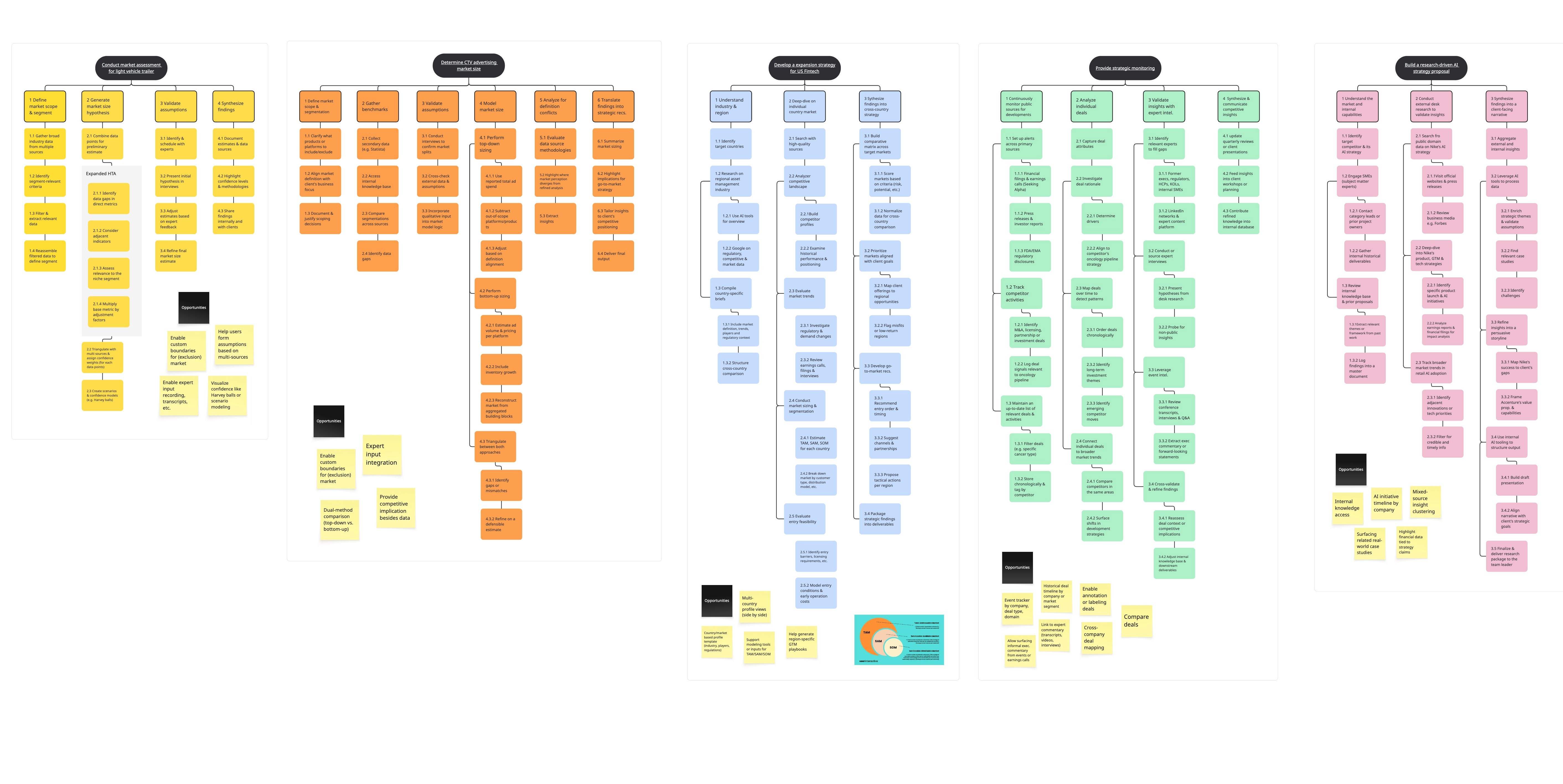
AI-assisted task analysis on TA's use cases
Analyzing Research Outcomes & Insights
To translate broad research insights into actionable design direction, I used AI to break down high-level workflows into detailed task steps within consultants’ JTBD. AI helped me extract, group, and reorganize complex information quickly, saving time on manual synthesis and allowing me to focus on interpretation and design impact. This analysis directly informed the new information architecture for the redesigned company profile.
Brainstorming & Ideation
I used AI to expand my ideation beyond individual data points by exploring how multiple signals could be combined into richer insights. After feeding AI with the JTBD defined through research and the mapped company data points, I generated concepts that leveraged our strength as a content aggregator. For example, when ideating on financial performance, besides the revenue for the current year, I included historical data, which includes extraction and calculation, and showing trends based on timeframe. With the trends and changes, users can then leverage our valuable content to learn the "why" behind it. AI helped me accelerate this combinational thinking while staying grounded in user workflows.
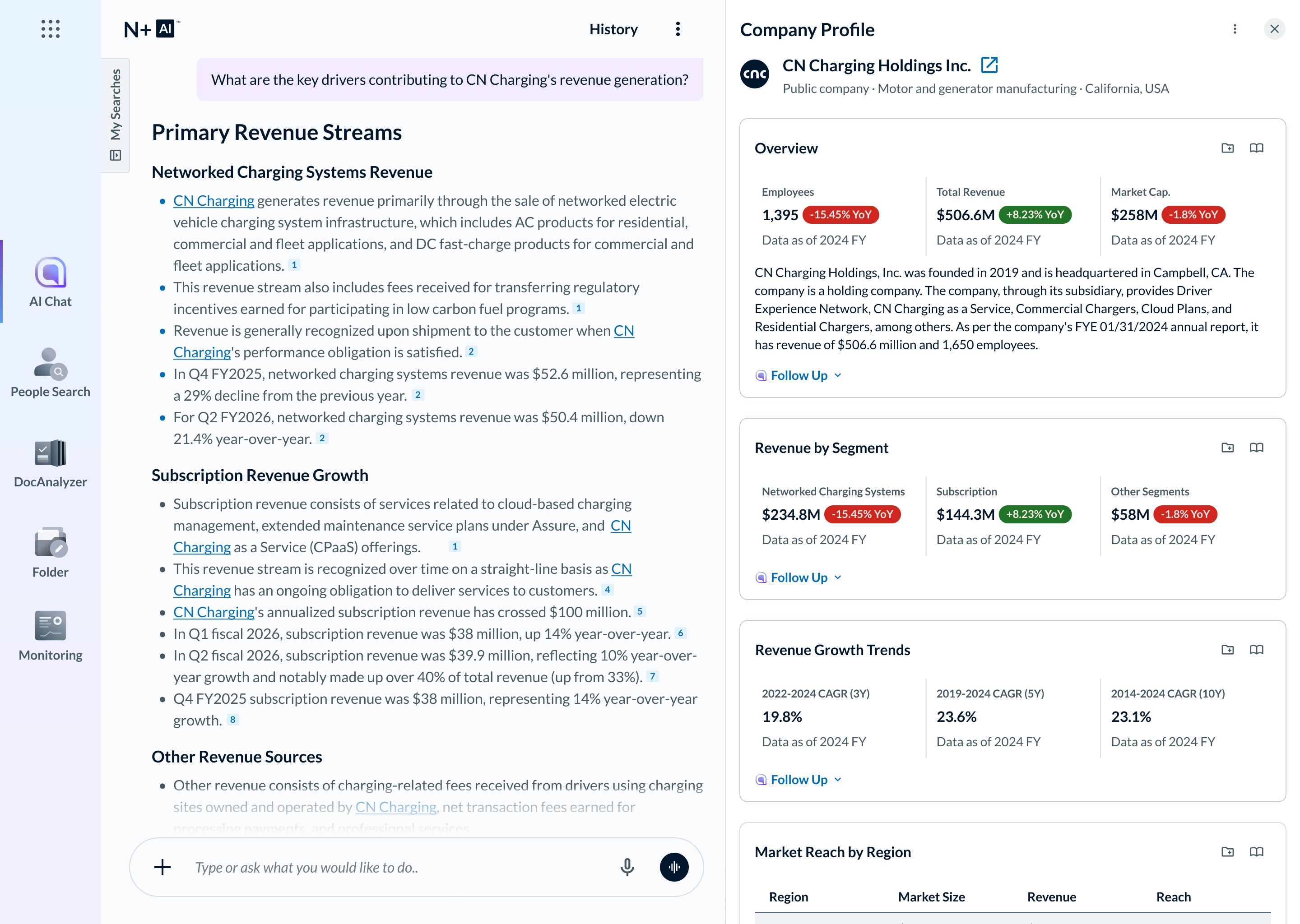
Company profile redesign - Synthesized M&A data page
Generating Real-world Mock Data
To reduce cognitive friction during stakeholder reviews, I used AI to create realistic company data for prototypes, enabling clearer communication and faster alignment. AI also supported micro-decisions such as naming, phrasing, and labeling, where I, as a non-native speaker, could quickly explore language options and select terminology that felt both accurate and intuitive. This improved both the fidelity of early designs and the efficiency of my workflow.
Conclusion
Designing with AI has meaningfully increased my productivity and expanded how I approach problem-solving. For example, when learning how our target audience-management consultants, actually works. I previously relied on search, job descriptions, and research artifacts. With AI tools, I can now generate an initial end-to-end workflow in seconds, then dive deeper into specific tasks and decision points such as understanding when market sizing is approached top-down versus bottom-up, and why each method is used in different contexts. This allows me to build domain understanding faster while still validating assumptions through research.
On the creative side, AI has become a powerful catalyst rather than a replacement for design thinking. It helps me quickly generate starting points for exploration, which is especially valuable given that users often articulate what they don’t want more easily than what they do. Early, rough ideas accelerate ideation and give me something concrete to refine and test with users. As a practical bonus, AI has also eliminated the need for Lorem Ipsum, allowing me to generate realistic and meaningful mock data that improves design fidelity, stakeholder conversations, and early validation.