
Designing Through Constant Change
Nexis+ AI is an emerging intelligence platform designed to support deep competitive and company research. The product direction evolved significantly, from migrating our legacy company research tool to targeting a new primary user group: management consultants.
My role expanded from designing parts of the company profile to leading the end-to-end company research journey, one of the core pillars of Nexis+ AI alongside Document Analyzer, Monitoring, and Conversational AI Chat.
Confidentiality Notice: The designs and visuals in this case study have been intentionally modified to comply with NDA requirements. My goal here is to demonstrate how I approach product design challenges, not to disclose proprietary details.
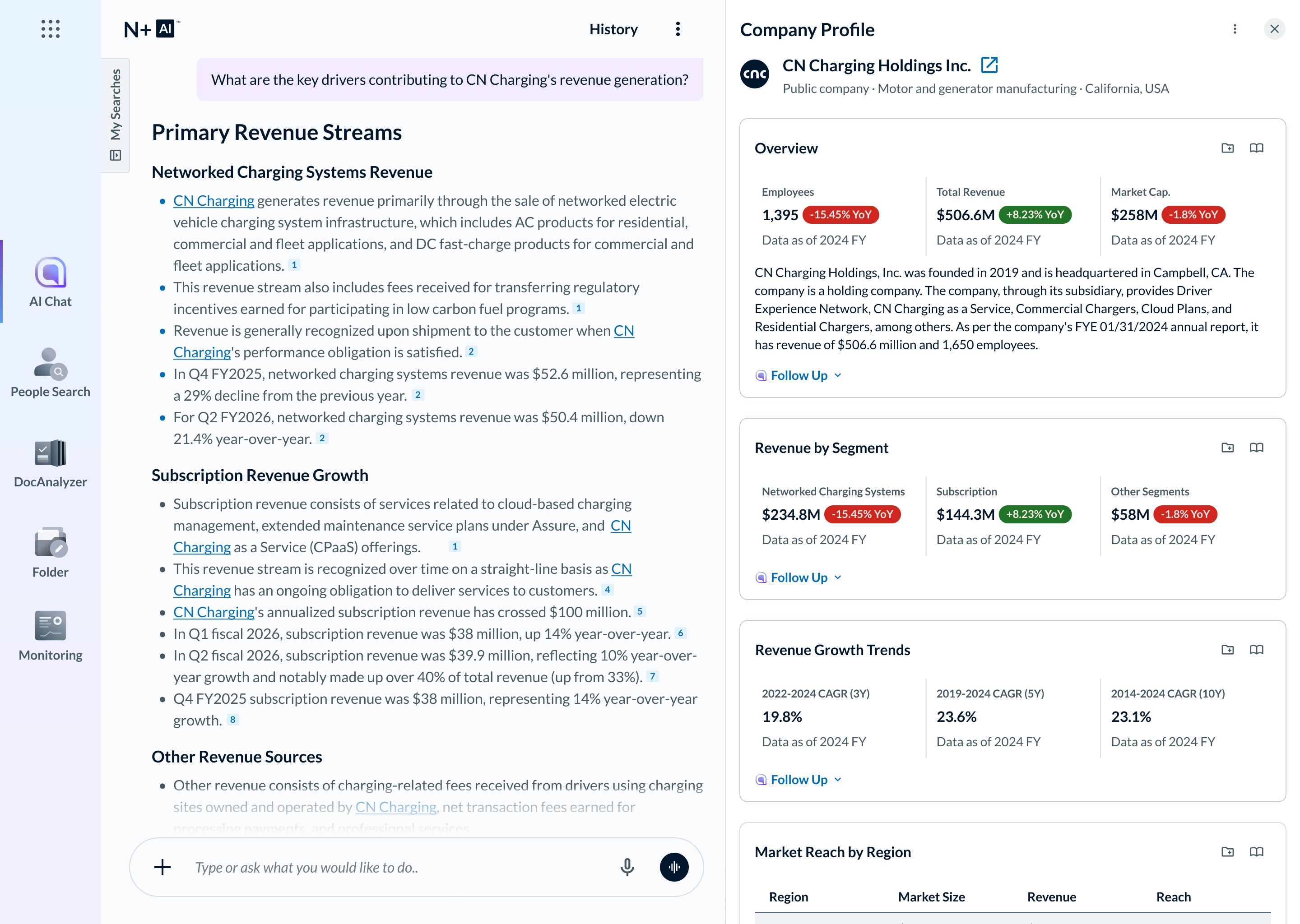
Nexis+AI company profile displayed alongside AI chat
Company
LexisNexis, UK
Project Kick-off
2023
Industry
Information technology
Product Type
AI-led, Saas
Organization (BU) size
100+
Problem Statement
Management consultants reported that traditional company profiles were not useful for strategic research. The information surfaced was shallow and generic, creating dead ends in their workflows. This forced users to navigate multiple pages and manually piece together insights, which adds cognitive load and slowing down their analysis.
Business Impact
I shaped product direction for Nexis+ AI in a high-ambiguity, early-stage phase, translating insights from 10 real-world user use cases into clear priorities, and delivering 20+ shippable company search features within the conversational AI experience. By aligning stakeholders with clear rationale and making pragmatic trade-offs across data, feasibility, and consistency, I reduced rework and accelerated delivery through three major strategic pivots.
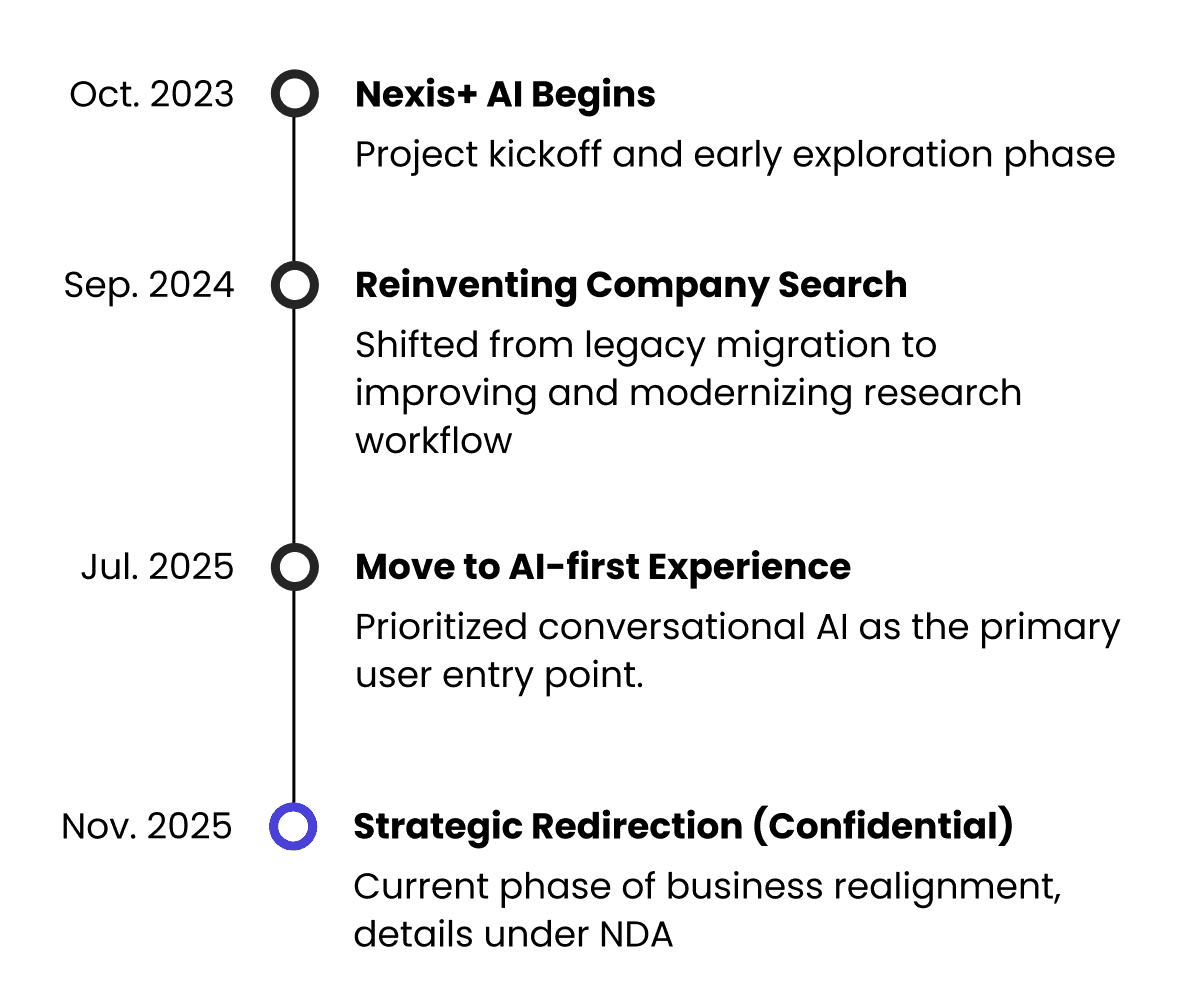
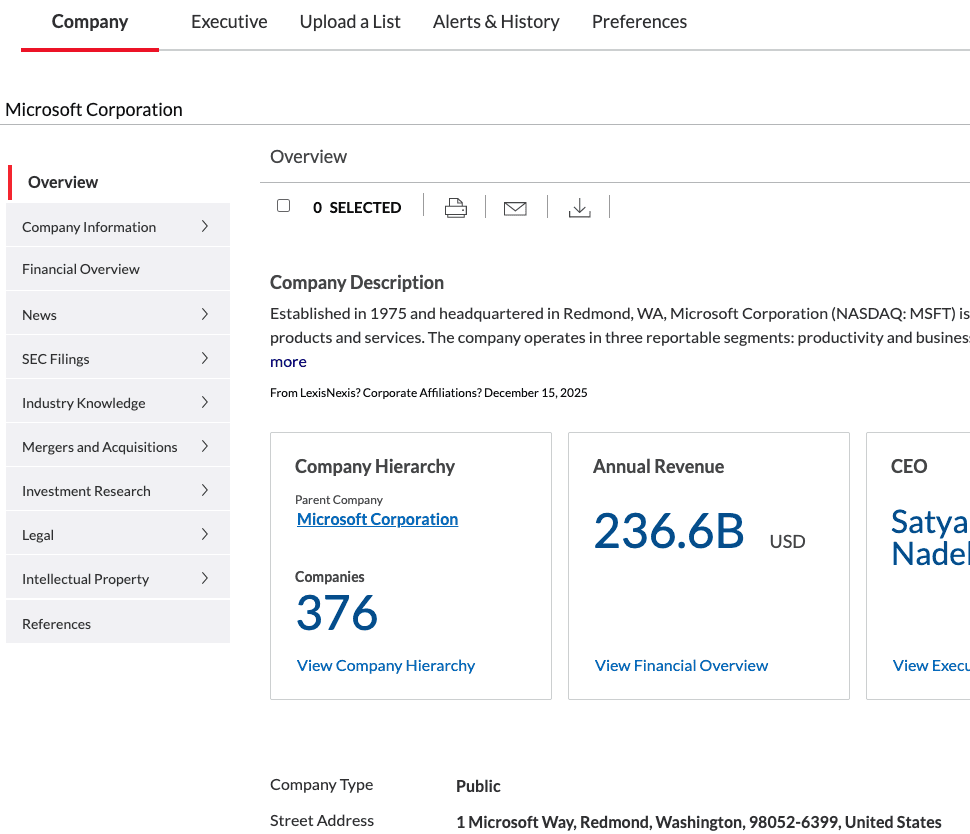
Interface of the legacy company search product
Turning the First Pivot into Progress
The project began as a straightforward redesign of our legacy experience, but early research quickly revealed that simply replicating existing functionality would not support our new audience or their depth-oriented workflows. I identified that the core issue wasn’t the interface itself, but the lack of granular, meaningful data needed for strategic analysis. Around the same time, the business set a direction to explore AI-driven capabilities, which introduced new opportunities and constraints.
Rather than starting with AI as the solution, I focused on understanding the underlying problem - the information gaps, and used AI only where it meaningfully enhanced clarity, insight, or efficiency.
“AI shouldn’t replace thinking, it should strengthen it.”
For this project, I decided to utilize Lean UX methodologies that would help me adapt through shifting priorities while keeping the experience grounded in user needs.
Design Process
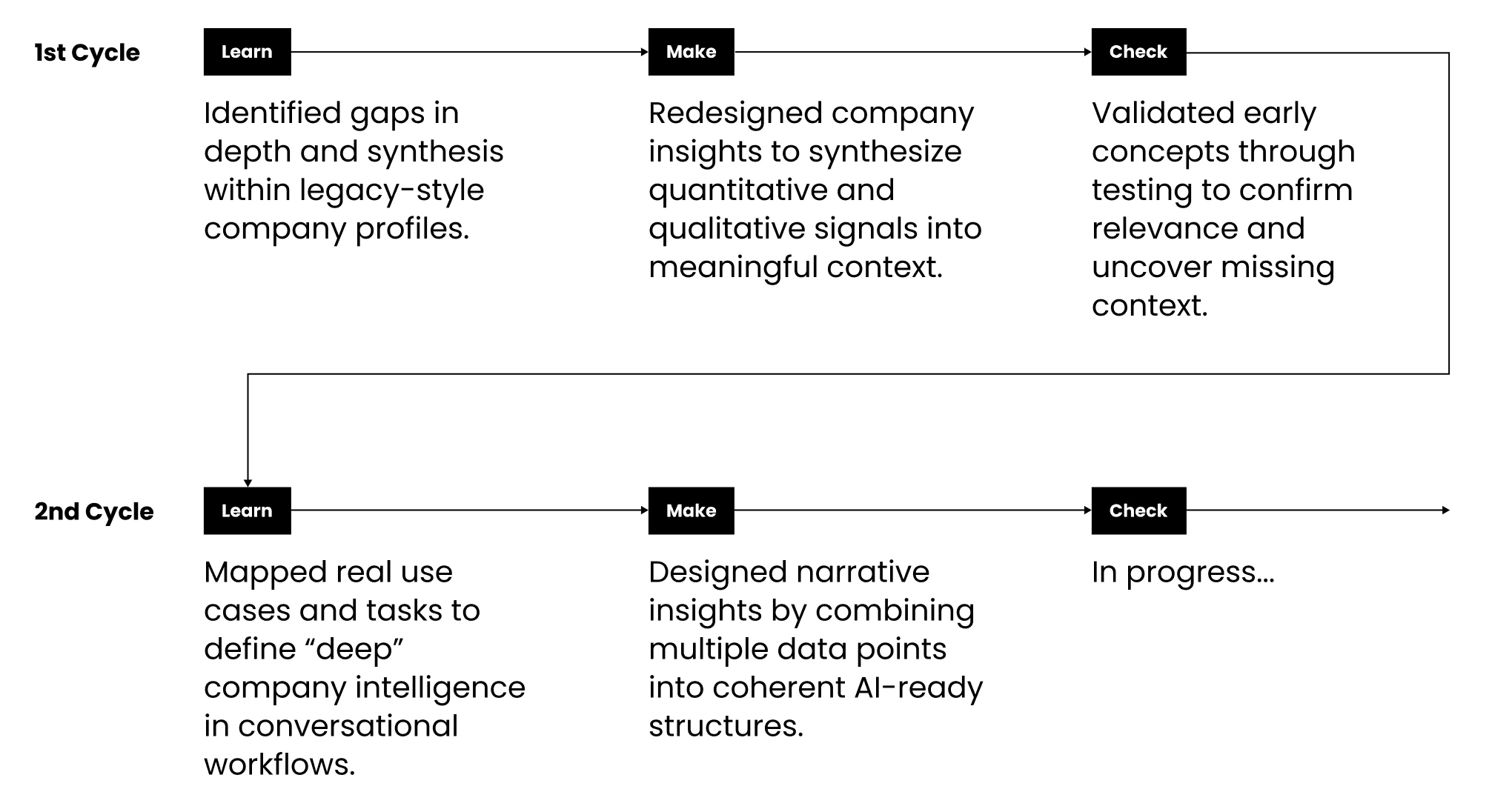
Learn
User sessions revealed that although having company information in one place was useful, the content lacked depth and meaningful synthesis—mirroring limitations in the legacy product. To understand what “useful” really meant for our new audience, I studied management consultants’ Jobs-To-Be-Done and conducted desk research into how they analyze companies in real workflows.
Make
With this understanding, I explored designs that went beyond our existing UI patterns. Instead of simply presenting financial statements, I reframed them into actionable insights such as revenue by segment, and expanded qualitative content by creating synthesized summaries and extractions from annual reports rather than surface-level snippets.
Check
I prototyped a new Company Report feature that generated both qualitative and quantitative insights with a single action. Collaborating with my PM, we tested with 4 prospective users to validate early ideas and gather nuanced feedback. These sessions clarified what truly mattered. For example, in M&A research, users prioritized deal context such as timing, status, value, and rationale over basic announcements or headlines.
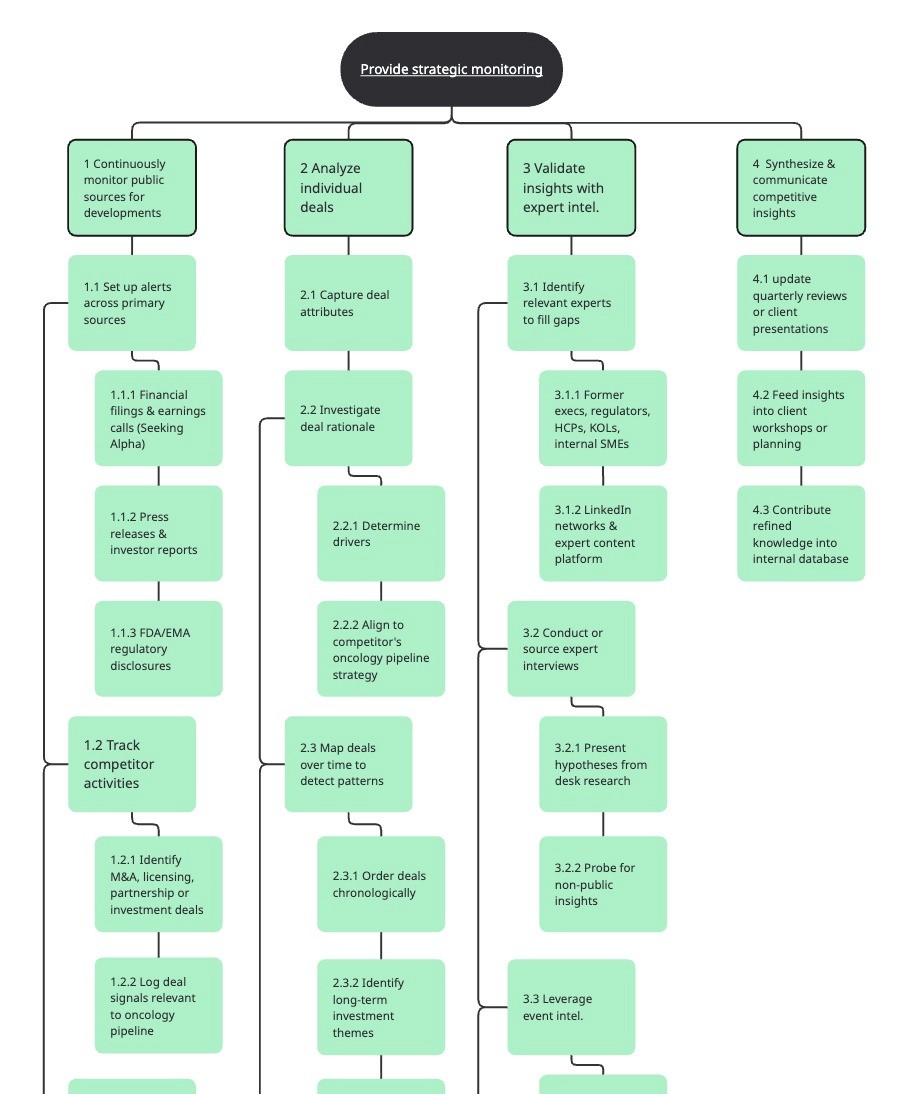
Research-based use case task analysis
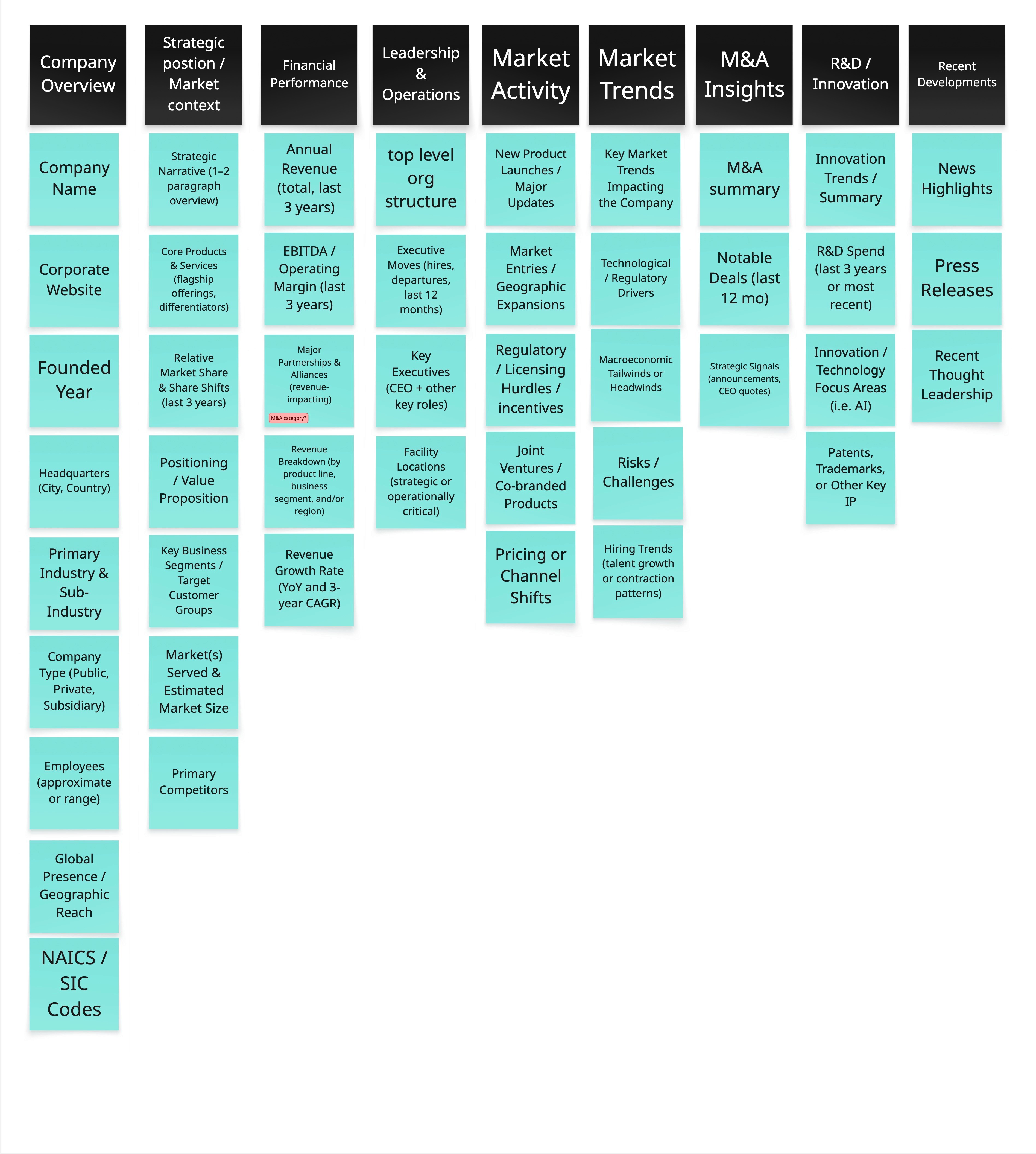
The company profile information architecture redesign
Adapting to the Second Pivot: From Structured Search to AI-First Conversations
The next major shift came when business redirected the product towards an AI-first chat experience, meaning users would now begin their journey through conversational prompts rather than traditional search. This pivot required me not only to define which company insights mattered most, but also to translate them into a conversational, ChatGPT-like flow enriched with deeper and licensed content.
Learn
Before designing for conversational AI interactions, I first needed to determine what “deep” and “valuable” company information truly meant for our users. I immersed myself in the use case inventory created by our research team, conducted task analysis, and mapped the data points involved in each step of a consultant’s workflow. By processing these insights and brainstorming how information could be synthesized, I developed a new information architecture for the company profile that reflected the level of depth and context users actually needed.
Make
To address the core problem of data depth, I redesigned the company profile alongside the chat and surface the signals consultants actually use to compare companies. For instance, instead of relying on total revenue alone, I prioritized revenue by segment and its trends so users can benchmark like-for-like performance within the same market or line of business. This is especially important when companies operate across multiple industries or product lines. Segment-level context helps users understand what’s really driving growth and decide whether to deep dive into supporting documents or continue the conversation.
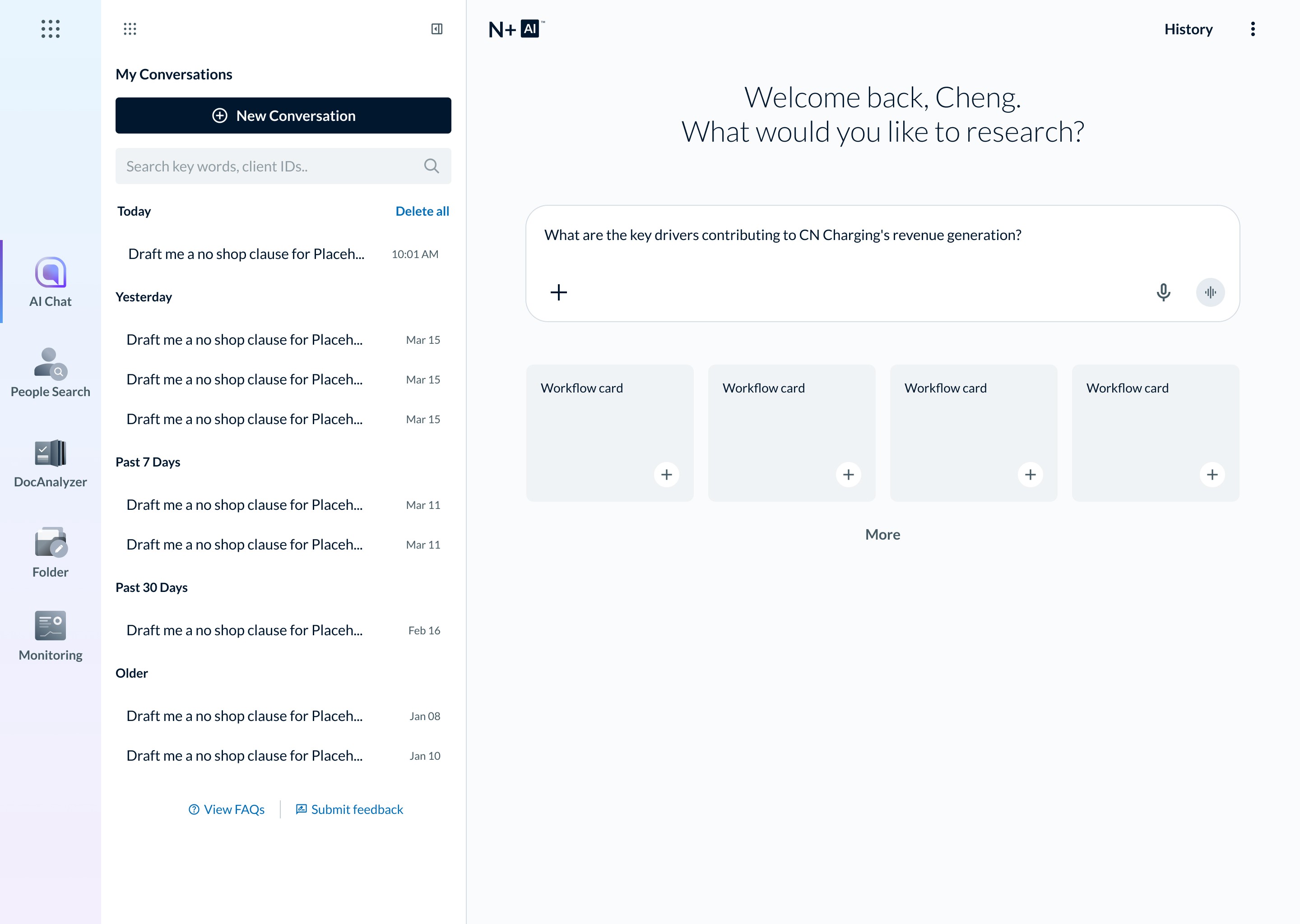
Starting from AI chat homepage
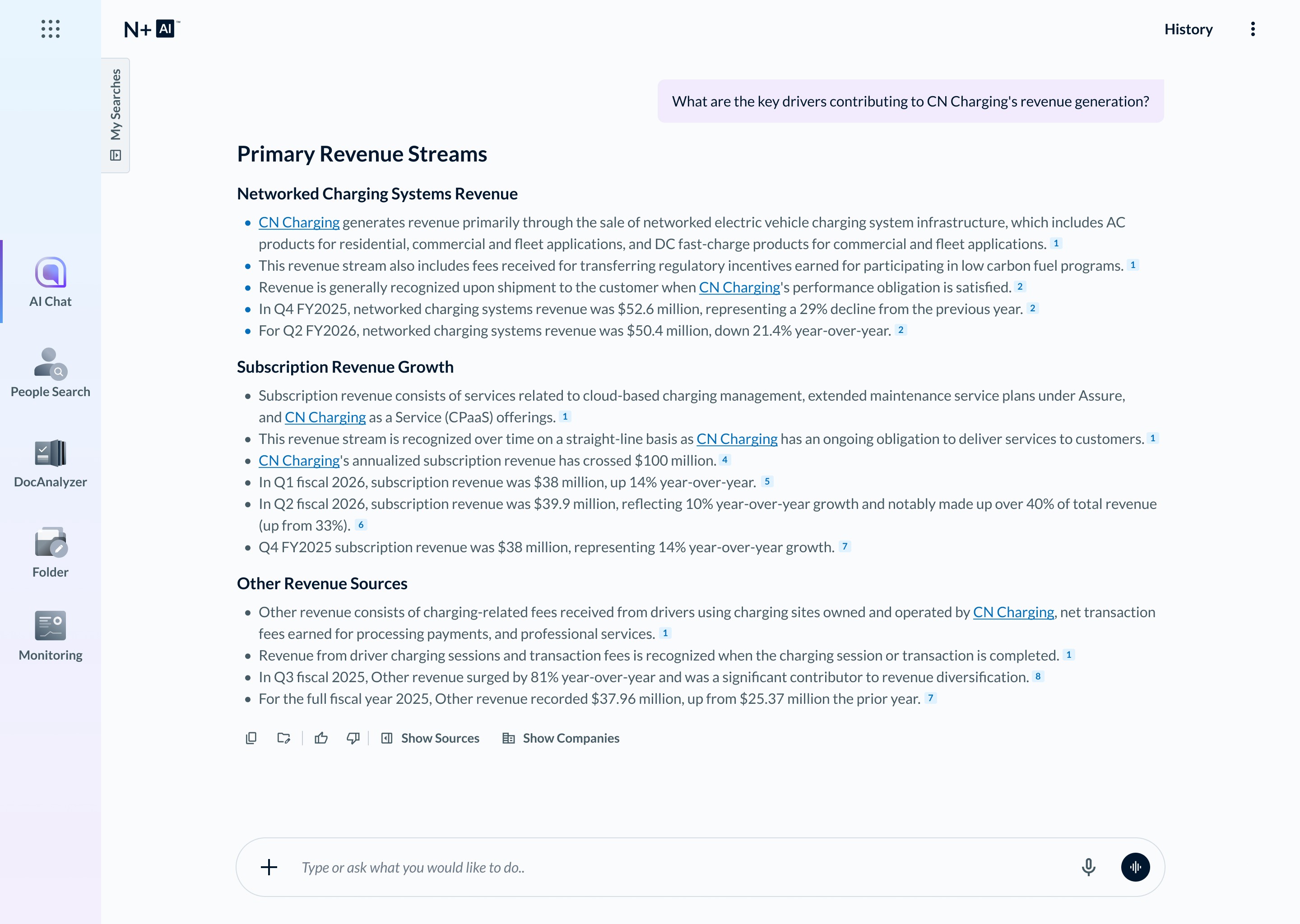
Getting AI response
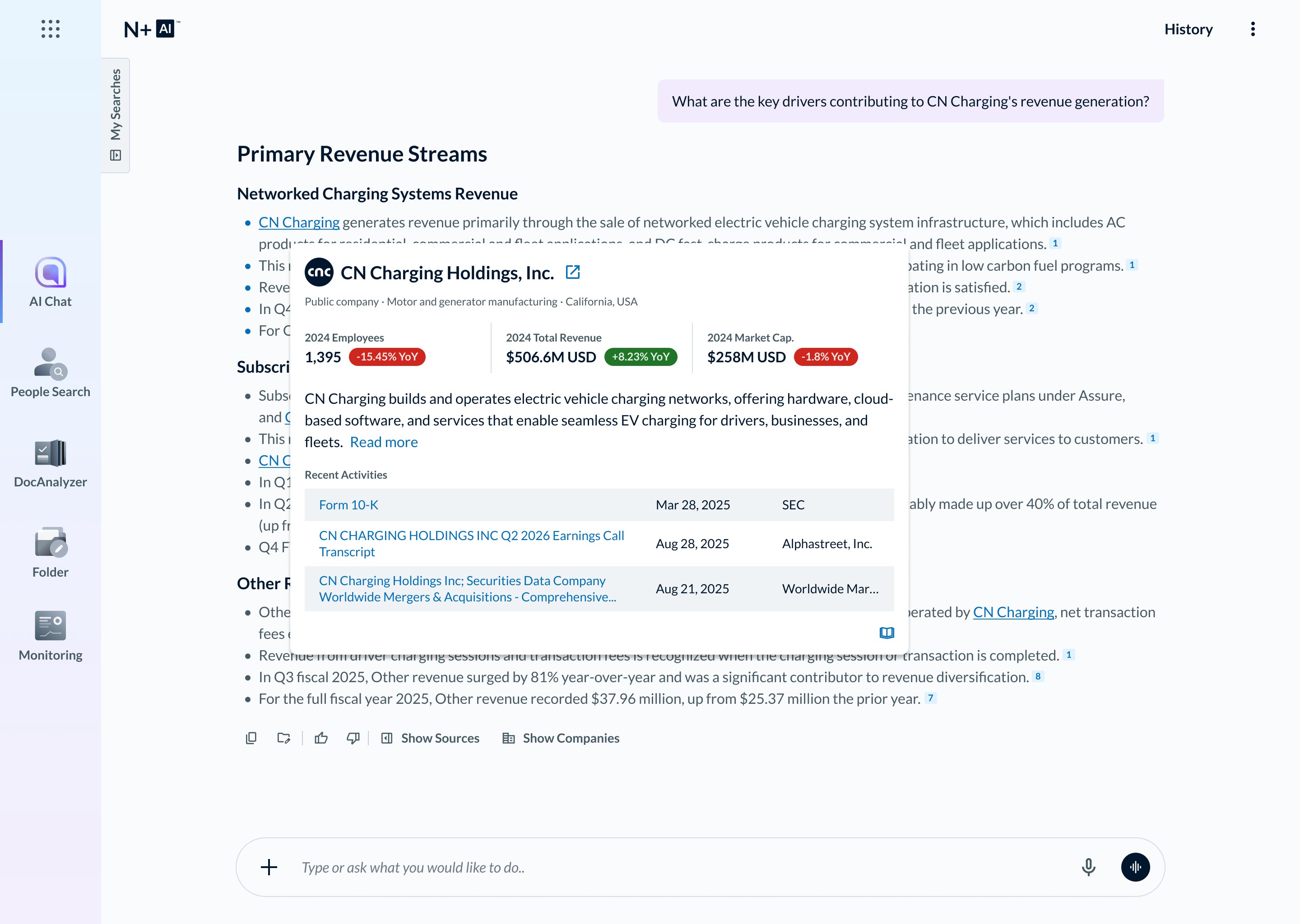
Previewing company data
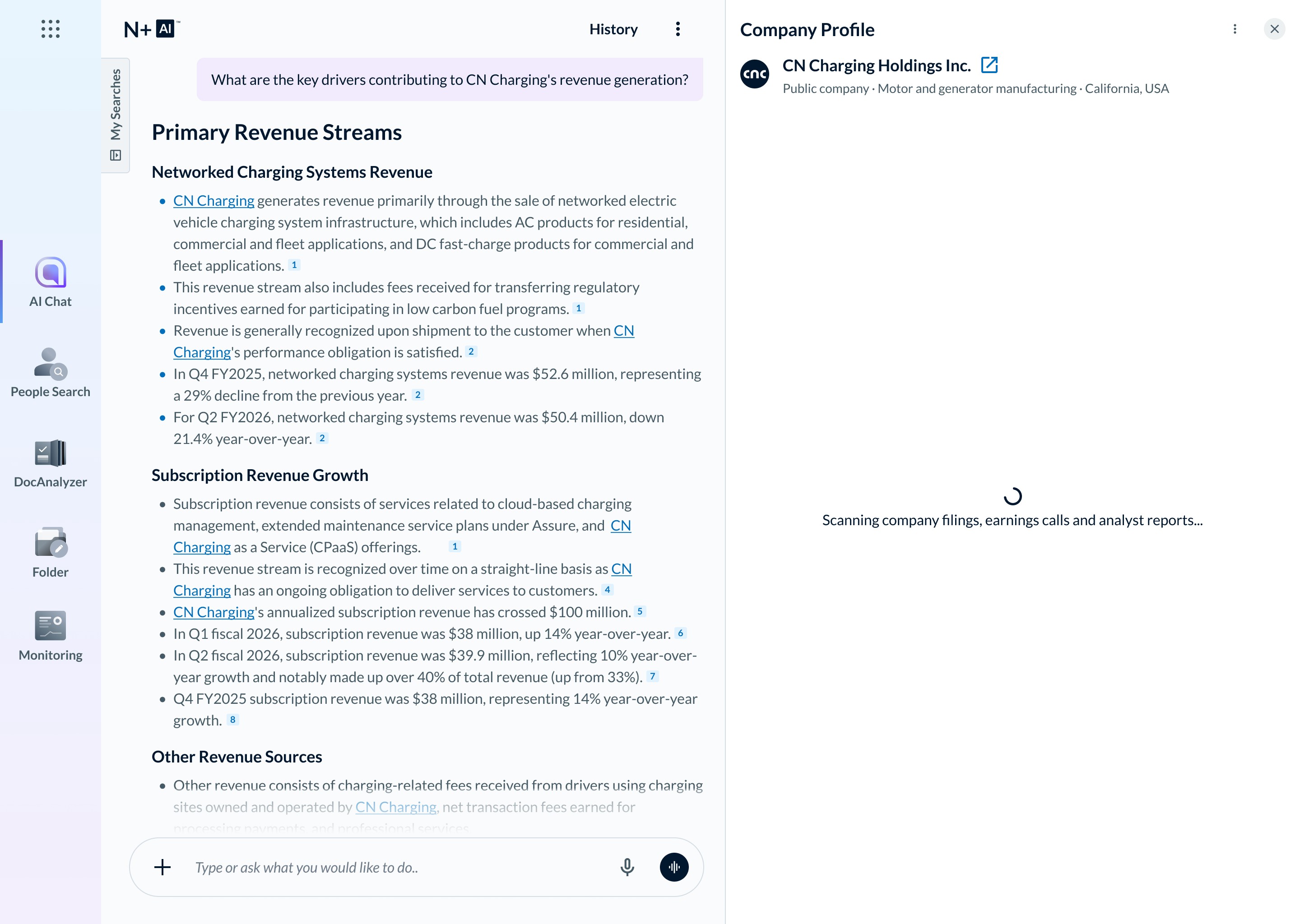
Waiting for the system rendering data/info
Viewing a complete company profile
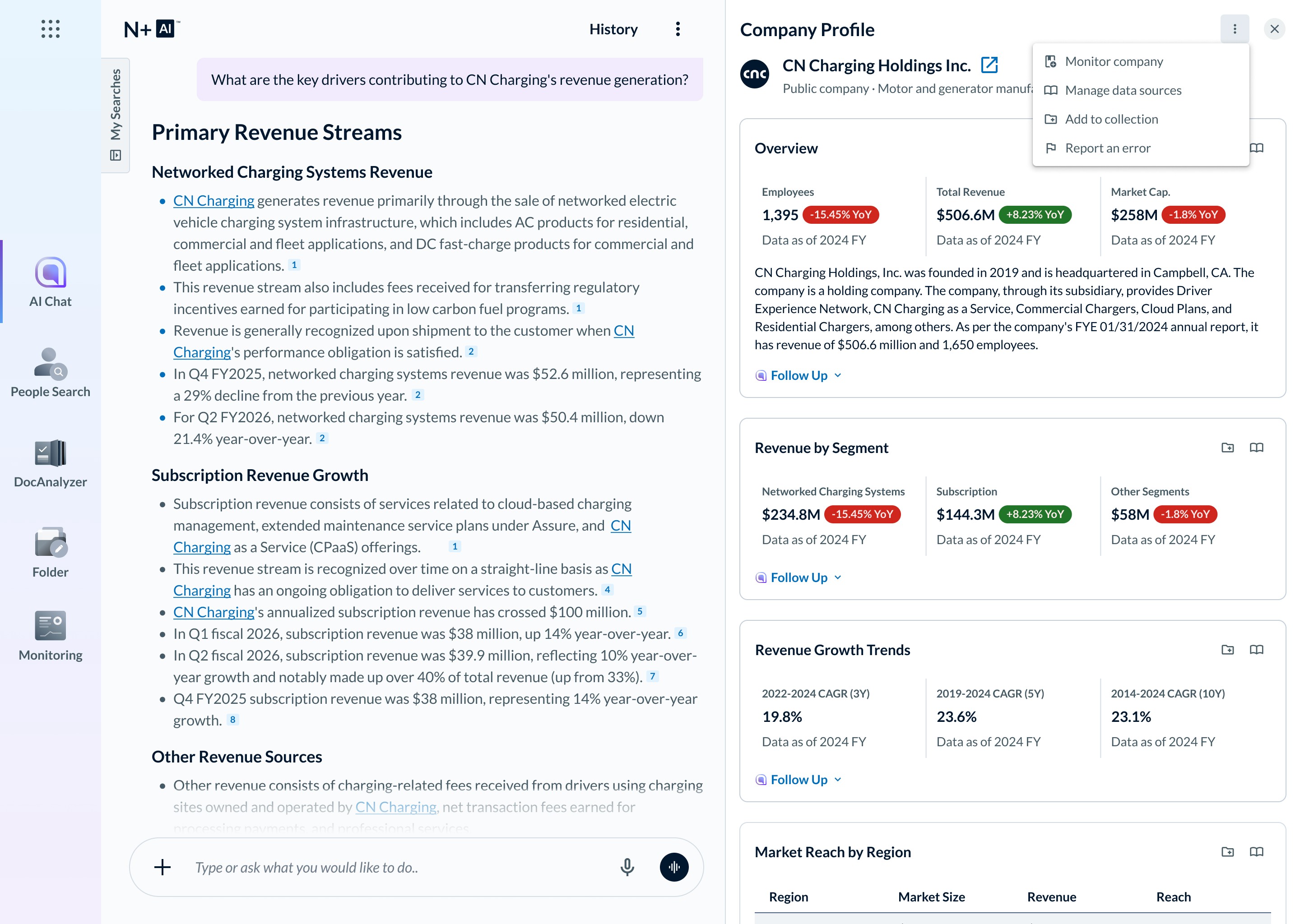
Actions available on company profiles
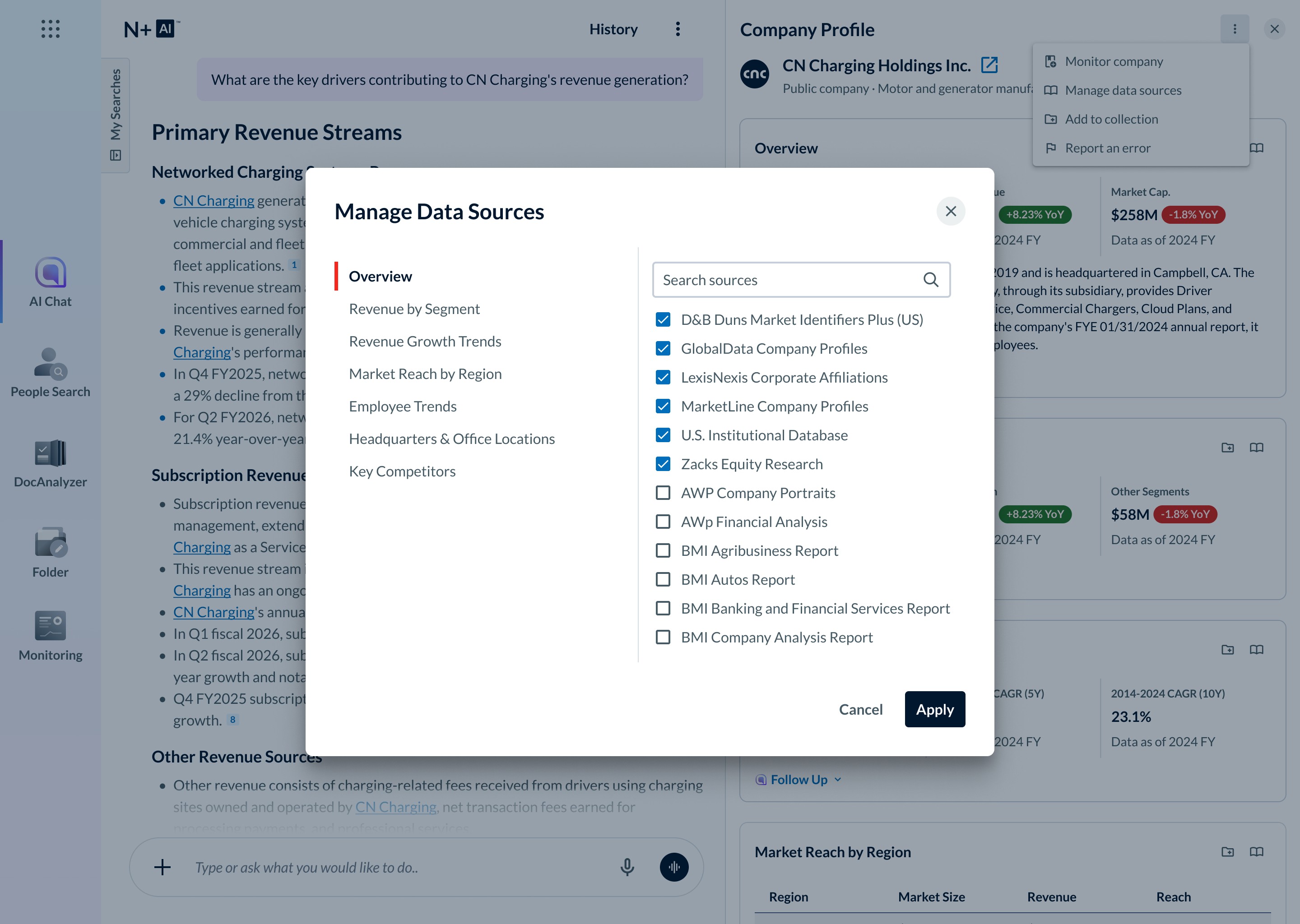
Managing data sources of the company profile
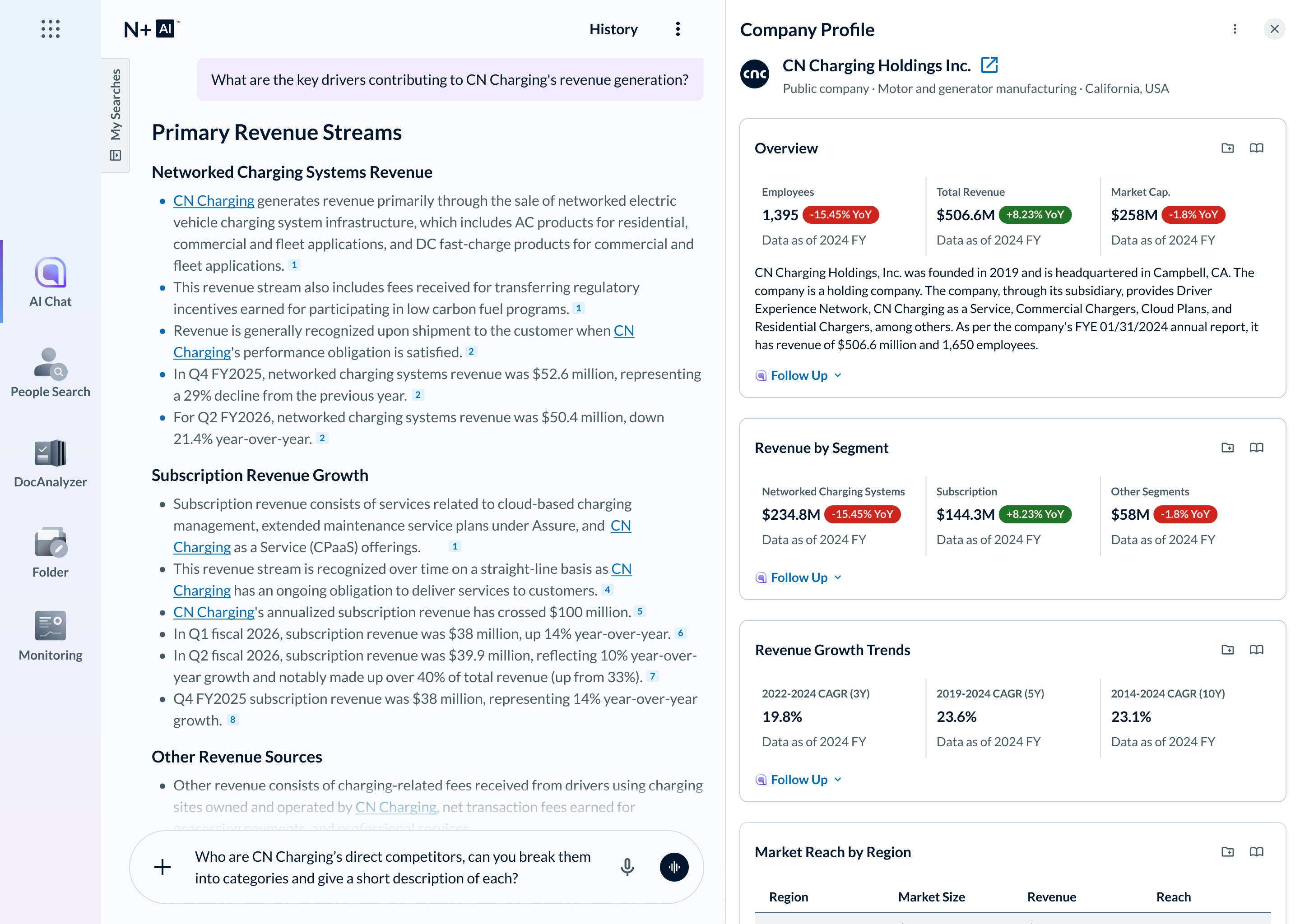
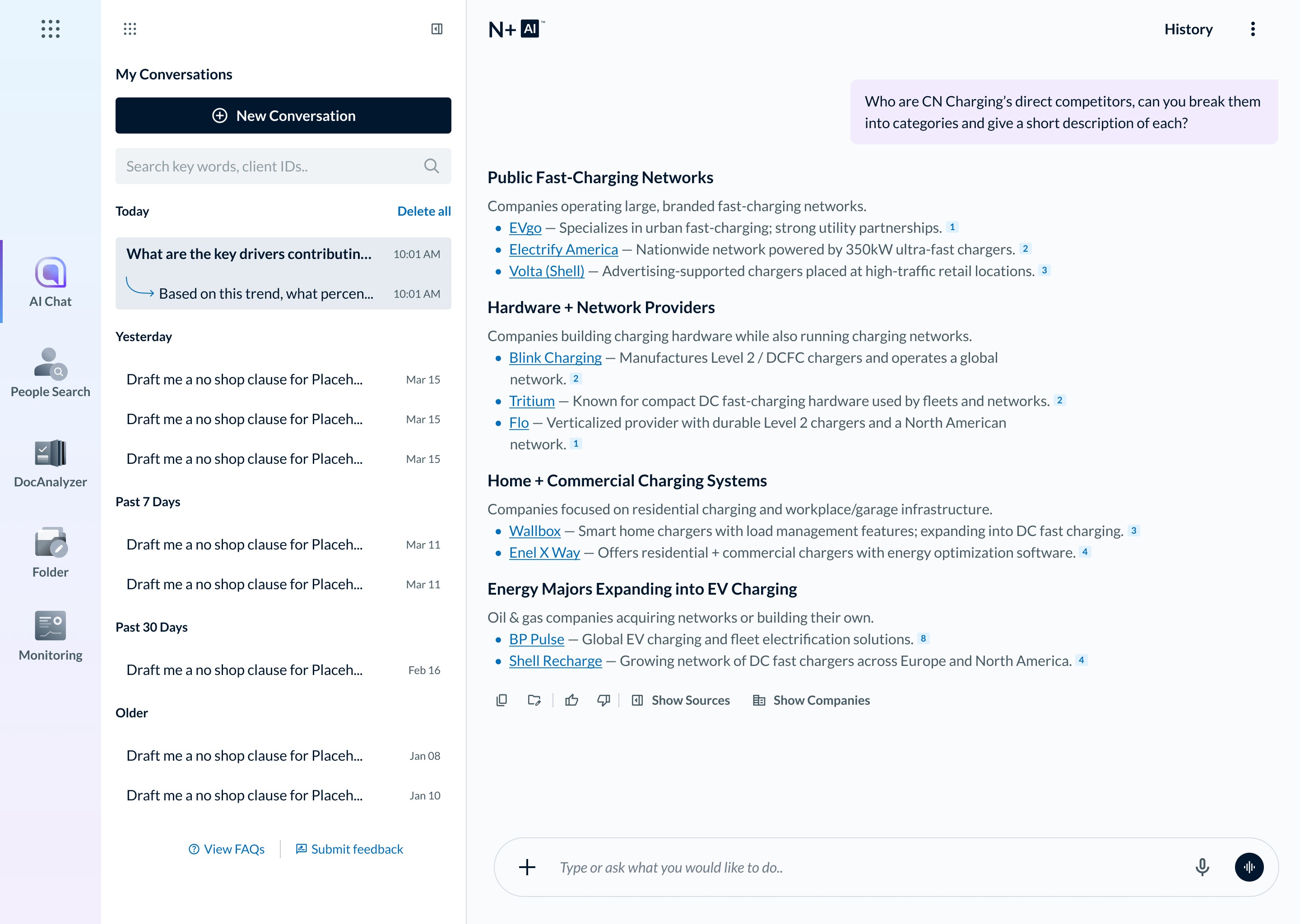
Entering the second prompt - competitors
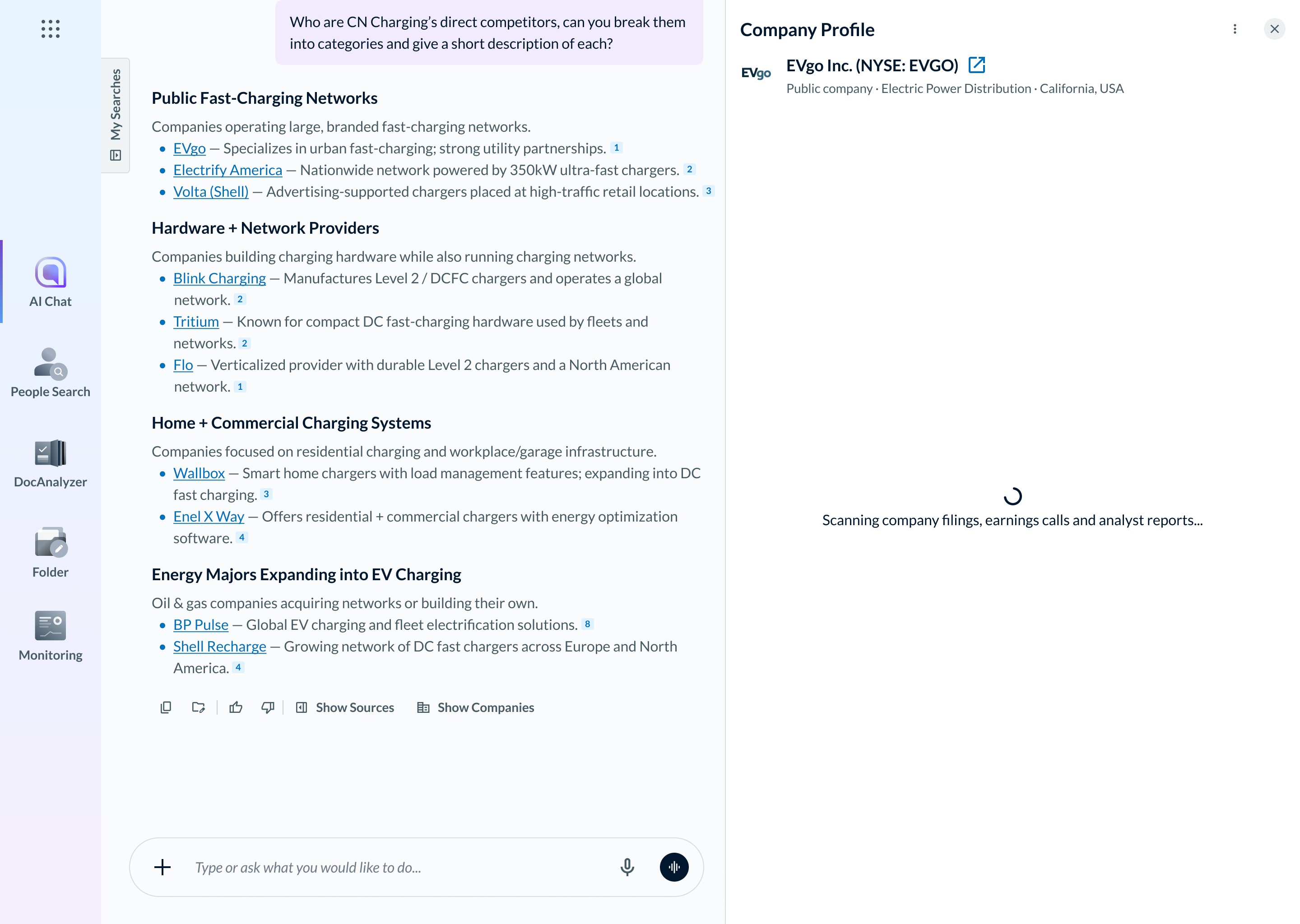
Checking on another company from 2nd response
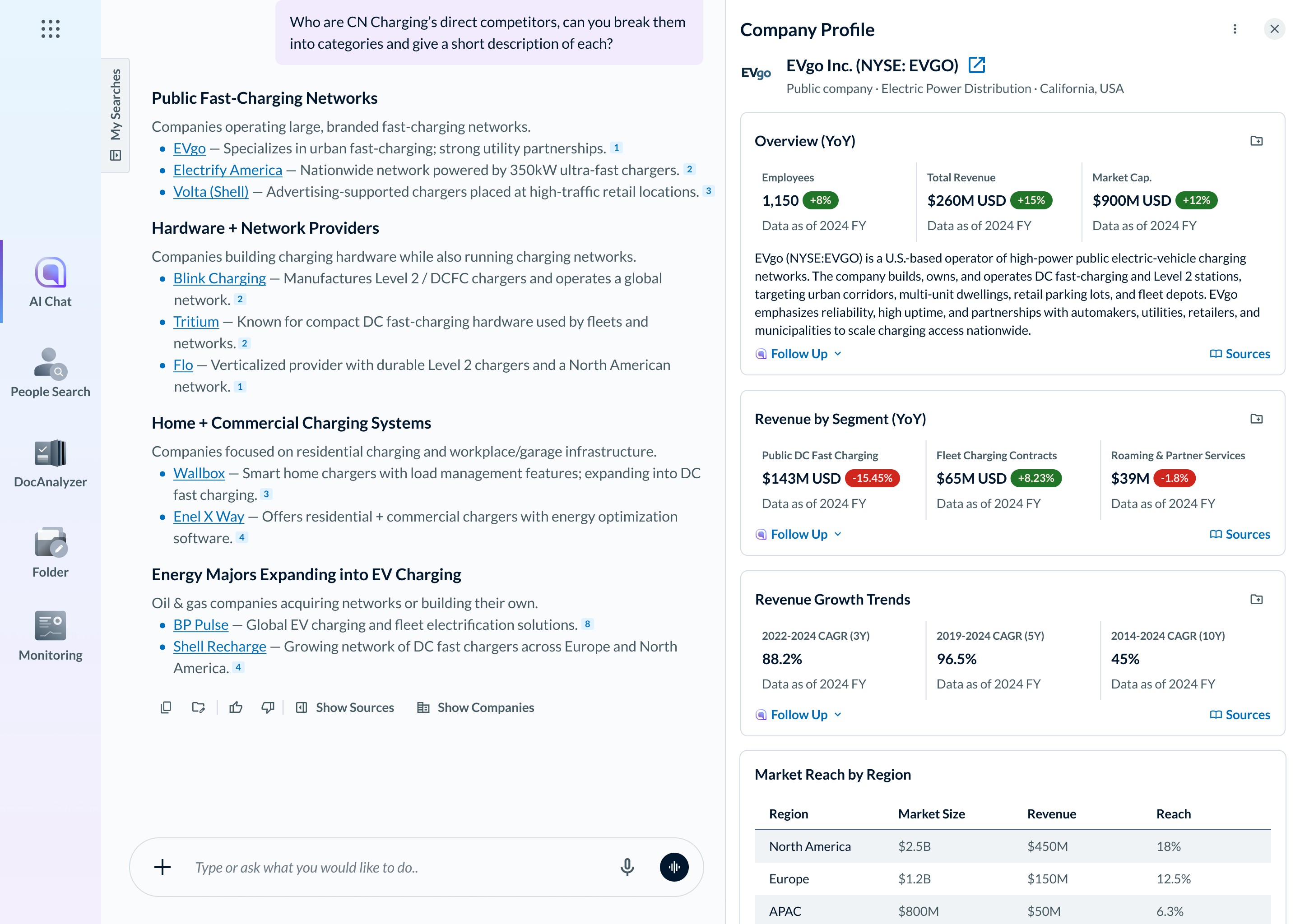
Viewing the competitor's profile
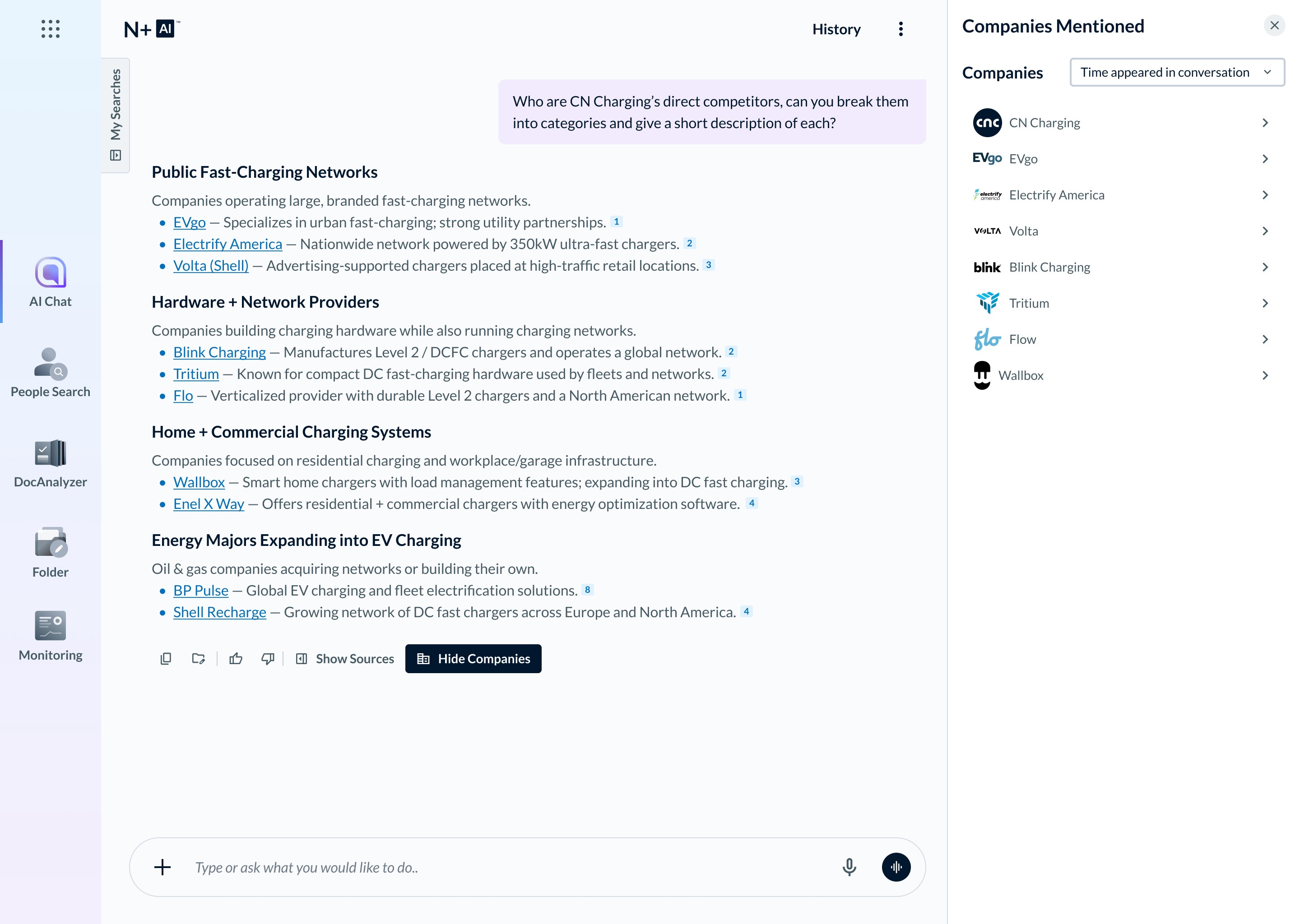
Viewing multiple companies from the response
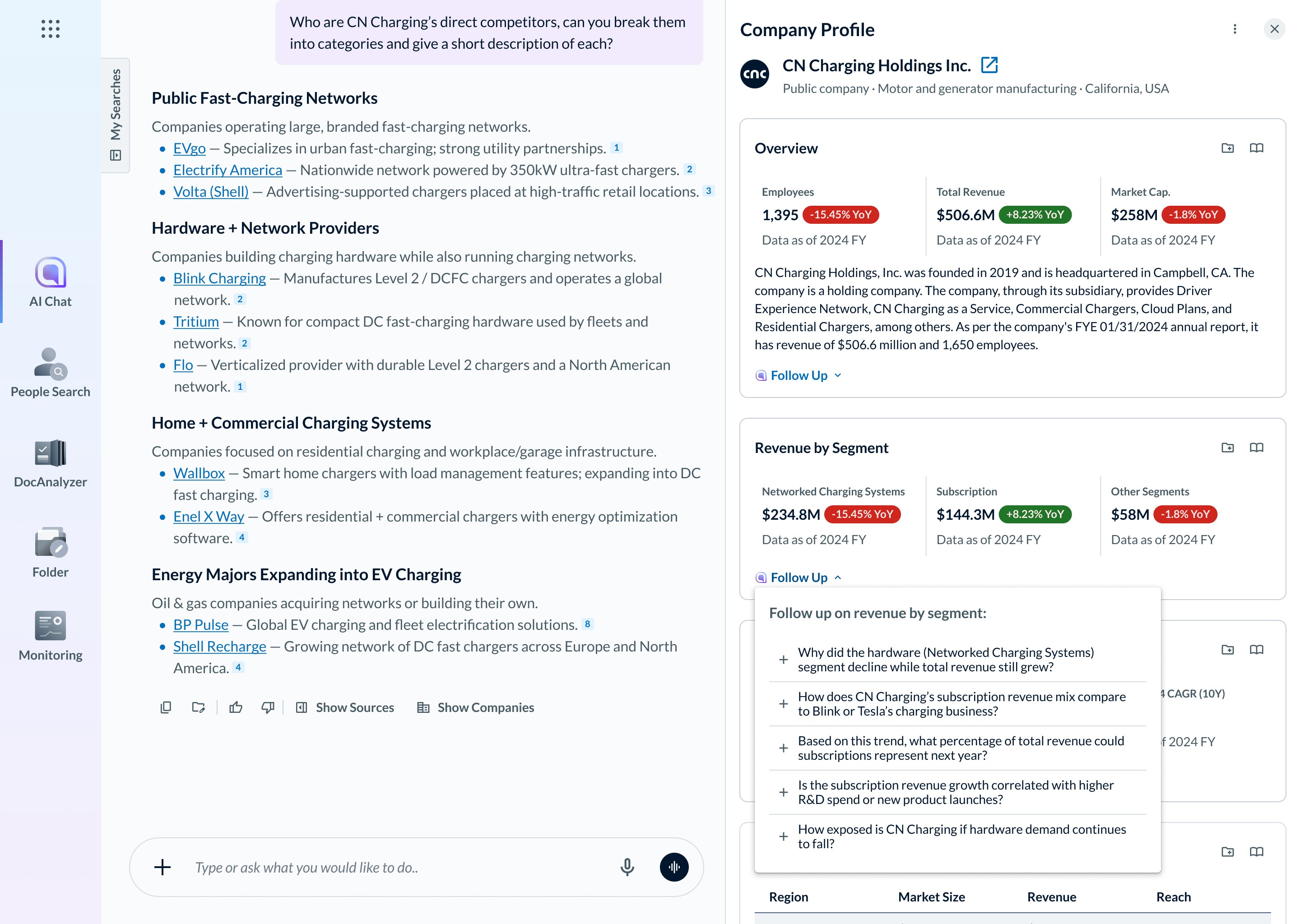
Following up on a specific data point
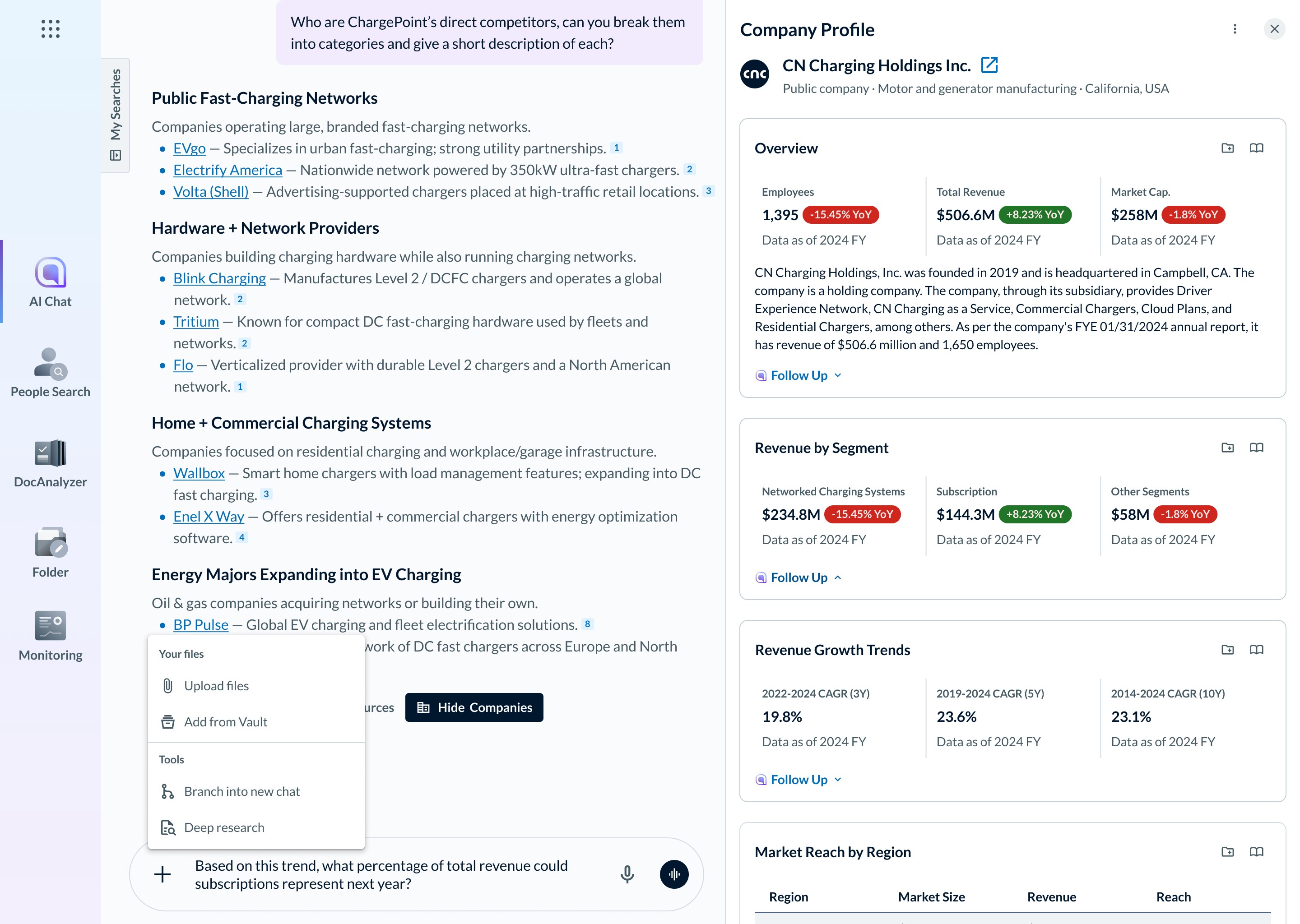
Viewing options to follow up with the prompt
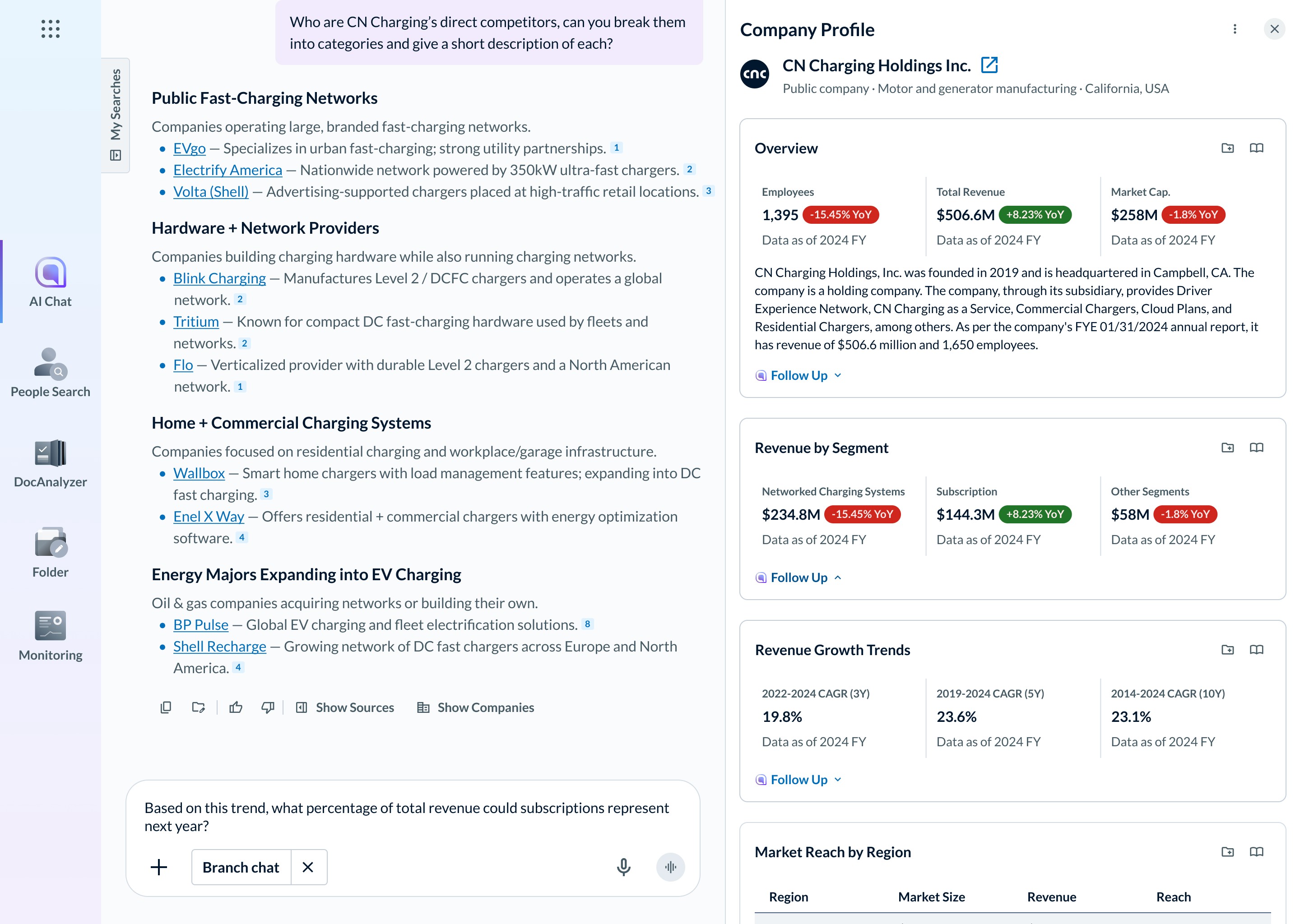
Selecting branching into a new chat
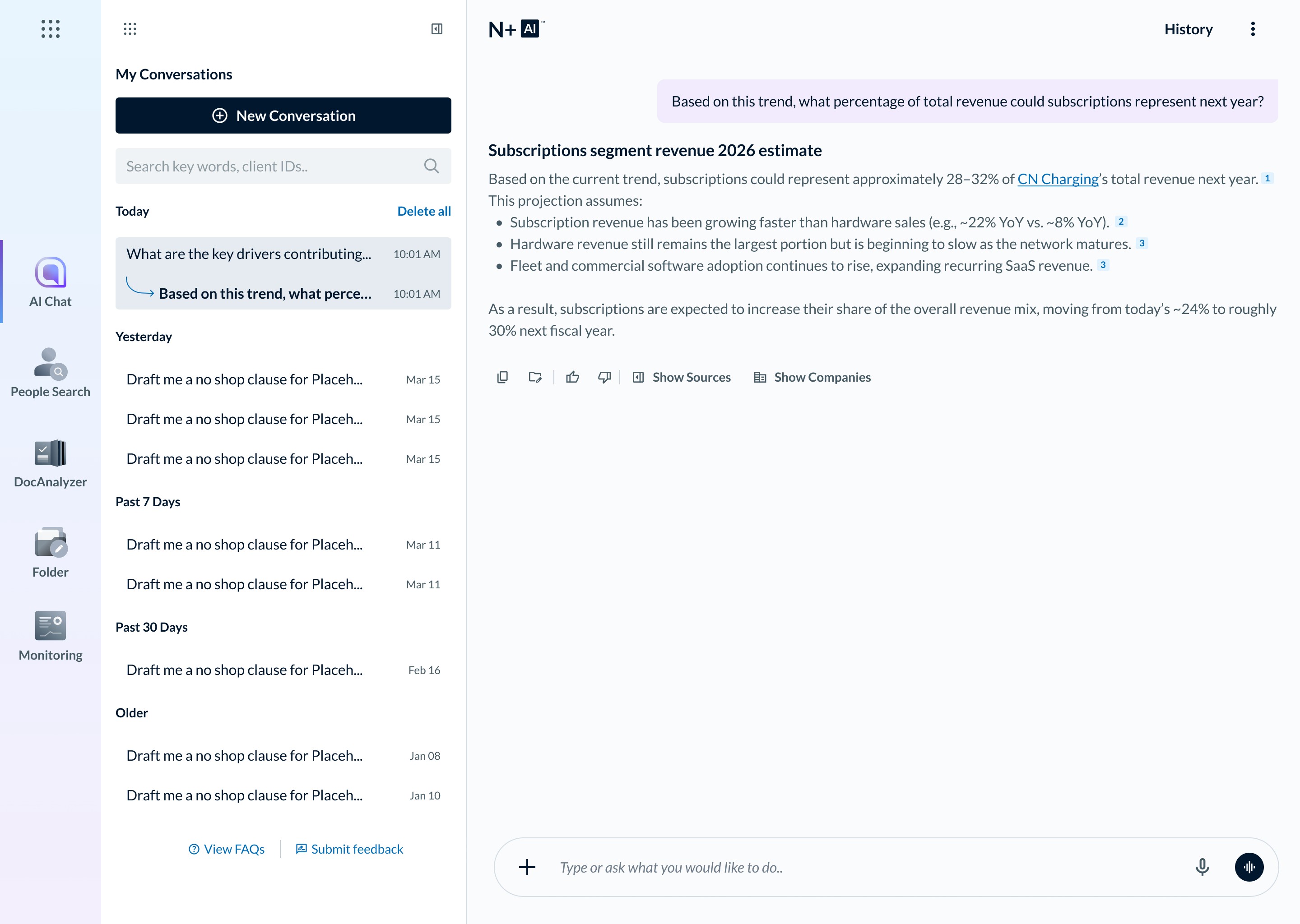
Branching the chat under the main chat
Back to the main chat to continue research
Next: Check the End-to-end Experience
The next Check stage is underway. Nexis+ AI is now more mature in terms of data availability, AI capabilities, and ecosystem functionality, and the business is progressing toward several opportunities where Nexis+ AI may be included in bundled subscriptions. As we prepare for broader usage, the next phase focuses on collecting behavioral metrics that help us validate assumptions, measure value, and refine the experience.
Clicks on the company preview & company names from the chat
The preview is designed from research insights and real-world use cases to surface high-signal indicators such as employee and revenue trends, and the latest M&A news. Tracking click-through on the preview card and company names will help validate whether these cues are sufficient to prompt deeper exploration (e.g., opening the slide-in profile or source documents), and whether the preview also builds confidence that users have identified the right company before continuing their research.
Actions taken in the slide-in company profile during AI conversations
Users can view additional company insights from chat responses, save information, manage sources, or explore details by section. Monitoring these actions will help us understand which data points users rely on most and how conversational and structured views work together in real workflows.
Selection of pre-defined follow-up questions
Each company is introduced with a default profile containing core attributes (e.g., status, industry, revenue, market cap, growth trends). Tracking which synthesized follow-up questions users choose—and how they customize their preferences—will inform what an “ideal” company profile looks like for different user types.
User paths when benchmarking companies on Nexis+ AI
Research shows that consultants trust fact-based content from official documents more than generative outputs. Analyzing user journeys and frequently accessed documents will indicate which sources are most valuable and highlight opportunities to expand or enhance our underlying dataset to improve product stickiness.